Monday, January 27, 2025

Two poems by Clare Harner in the Detroit NEWS

Properly credited to "Clare Harner," these short pieces from 1935-6 were submitted to Elmer C. Adams, longtime poetry editor for the Detroit News and published there in his regular newspaper column of "Random Shots." Both items may be found on genealogybank.com

Detroit News - November 6, 1935
via genealogybank.com

New Horizon

This friendly sky,
   This unchanging dome,
This is my refuge—
   And this my home.

You take the city,
   You take the sea!
I'll take the country
   Where I am free.

For the city is slavery;
   Loving is, too.
Goodby to the land . . .
   I'm going with you!

CLARE HARNER. [Detroit News, November 6, 1935]
***

Detroit News - November 6, 1935
via genealogybank.com

Turncoat

Turn the coat inside out
And flout
Its jaunty plaid to the sun.
What does it matter that one
Has worn it till it's old?
The inner hue is bold . . .
So turn the coat outside in
And grin!
 
CLARE HARNER. [Detroit News, February 4, 1936]
***

Tuesday, May 21, 2024

Clare Harner's "Immortality" selected by Hope Ridings Miller for reprinting in the Washington Post on Christmas Eve, 1934

On Monday, December 24, 1934 The Washington Post reprinted Clare Harner's original poem "Immortality" with five others, all by women. 

On page 12 under the head of "Gleanings from Current Verse," Hope Ridings Miller selected six poems from various poetry magazines including two from The Gypsy, "Immortality" by Clare Harner and "Christmas" by Inez Rice.

  1.  "Christmas" by Inez Rice, from THE GYPSY
  2. "Falling Snow" by Marie Barton, from CHOIR PRACTICE
  3. "Christmas in Tucson" by Berta Hart Nance, from KALEIDOGRAPH
  4. "Quaker Women at Meeting" by Sara Bundy Pence, from QUAKER BONNETS described as "a presentation brochure published by the Herald-Silhouettes Press" of Ontario, California.
  5. "Immortality" by Clare Harner, from THE GYPSY
  6. "The Star Child" by Claribell Weeks Avery, from DECIMAL
One unfortunate typo appeared in the Washington Post version of Clare Harner's "Immortality" which reads
"I am the day transcending light" 
where The Gypsy had 
"I am the day transcending night."

Monday, September 26, 2022

Kisses at the Turnstile Gate

Transcribed below from "Choir Practice," A Chorus of Contemporary Poetry, conducted by Ellen M. Carroll" in the Charleston Evening Post of November 13, 1936. The original poem "Kisses at the Turnstile Gate" is by Clare Harner, not "Horner" as misprinted in the South Carolina newspaper.

KISSES AT THE TURNSTILE GATE


I'll ride this way again, irresistibly drawn
   To travel once more the lonely road from the sea
   That you and I explored, glad just to be.
And I'll get off my horse to watch the dawn;
   I'll sit on the log beneath a maple tree
   And laugh at memories of you and me
Who sat there once and gave our hearts in pawn.

I'll listen to crickets, and hear the noisy trills
   Of jays. I'll trace the changing carpet, inlaid
   With leaves in rich mosaic, light and shade.
I'll watch the lizards hunt where the sunlight spills.
   I'll watch the twisting, silver brook invade
   The trees that rise beyond the farther glade,
And farther yet the distant blue of the hills.

I'll see all this again, and mock the past
   Because my pride is stronger now than hate:
   But when I pass the broken turnstile gate
I'll look the other way and ride by fast
   For I might see a phantom lover wait.
   
My pride is strong—but I shan't hesitate
Lest I recall your kisses, which could not last.

Clare Horner [Harner],
Kansas.


Charleston, SC Evening Post - June 11, 1937
Found on Genealogy Bank


No Need for a Band

From "Choir Practice," A Chorus of Contemporary Poetry, conducted by Ellen M. Carroll" in the Charleston Evening Post, November 13, 1936:

NO NEED FOR A BAND

In my little rut
   I serenely go,
Without swagger or strut
   Or fanfare or show.

No need to doubt
   The way I take . . .
I couldn't get out
   With less than a quake!

The path is fair
   I can't go wrong:
Without worry or care,
   I travel with song.
 Clare Harner.   Kansas. 


Charleston, South Carolina Evening Post - November 13, 1936
Found on Genealogy Bank

With Song

From "Choir Practice," A Chorus of Contemporary Poetry, conducted by Ellen M. Carroll" in the Charleston Evening Post, Friday, April 10, 1936:


WITH SONG

So little
Impression my life
Has made—like a rock skimming
The water, leaving series of rings
Widening, fading, gone. Yet—
Pebbles hum gay tunes
While they skip.
 Clare Harner.

Kansas. 


Charleston, South Carolina Evening Post - April 10, 1936
Found on Genealogy Bank

Friday, February 25, 2022

He May Not Choose

Here is another poem by Clare Harner collected in "Choir Practice," a monthly column of contemporary poetry selected by Charleston poet Ellen M. Carroll--this one appeared in the Charleston, South Carolina Evening Post on February 12, 1937; found on genealogybank.com.


Charleston Evening Post - February 12, 1937


HE MAY NOT CHOOSE


Man is ruler of mind,
     But the heart is master of man:
He can chart his course, to find
     That love can change the plan

-- Clare Harner, Kansas.

Wednesday, March 17, 2021

Three poems by Clare Harner


Shown above, page 274 from my personal copy of Important American Poets, ed. Edith Warren (Valiant House, 1938) with three poems by Clare Harner, later Clare Harner Lyon:

SCARECROW

(Hokku)

Hate is a scarecrow
That frightens all singing birds
From the fields of life.

PURITAN 

Corseted are my emotions
       Till I'm unwholesomely slim;
I'm laced with prescribed devotions --
       By nature, I'm not so prim!

SHE WALKED WITH THREE 

Three were the hounds that followed her,
       Though never far behind.
Relentless their walk as whispered slur --
       Illusions of harried mind.

And all who saw her thought her queer
       As she measured her hunted pace;
She looked as if a presence were near,
       With fright a veil for her face.

And only she knew the curs were there:
The hounds of envy, pride, and despair.

Wednesday, February 3, 2021

Facts about Clare Harner Lyon

This post gives documented facts about the author of "Immortality" aka Do not stand at my grave and weep. All items below have verifiable sources in public records and newspaper articles. 

Clare Harner Lyon (1909-1977)


Clare Harner in 1931

  • Clare Harner was born October 1, 1909 in Green, Kansas to Martha and R. C. Harner. Clare's father Romeo Catlin Harner was a respected physician in Clay County, Kansas. The Harners lived in Clay Center and subsequently in Howard. Both Clare's parents had moved with their families to Kansas from Indiana. 
  • Clare grew up in Howard, KS where Dr. Harner settled with wife and kids in 1912. She had two older brothers named Collis and Olin. (Sadly, Clare's brother Olin Wade Harner died on November 11, 1932, only 31 years old.) 
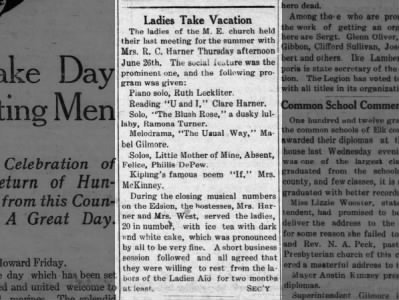
  • In Howard, KS the Harners belonged to the First Methodist Episcopal Church where Clare's mother Martha Frances Harner (née Hainey) taught Sunday School and served as "chorister" in the Ladies Aid Society. With her mother's example and support, Clare developed an early interest in music and poetry as evidenced by piano recitals and other performances that received notice in local newspapers. At the age of 9 Clare read the anonymous Sunday-school poem "U and I" for the church ladies meeting at her mother's house, held on June 26, 1919.
Clare Harner, 9 years old, readsClare Harner, 9 years old, reads "U and I" Wed, Jul 2, 1919 – 1 · The Citizen (Howard, Kansas) · Newspapers.com

U and I. 

All the letters of the alphabet
The righteous way should choose,
But two of them, especially,
Should mind their P's and Q's;
A deal of trouble in this world,
And much that goes awry,
Could be prevented easily
By these two, U and I.
If U and I are cross, you see
There's bound to be a fuss;
If U and I untidy are,
Somewhere there'll be a muss;
If U and I are selfish, there
Will some one suffer wrong;
If U and I rob birds' nests, why,
The world will lose a song.
If some one feels dejected, or
'Tis cloudy for a while,
The sunshine may come back again
If U or I but smile.
If U should grumble, whine, or pout,
Or I should snarl and fret,
A storm would soon be raging that
We should not soon forget!
So U, look out, and mind your ways!
And I must likewise do,
And keep a cheery corner where
The skies are always blue.
The A's and B's and E's and O's
Do work that's good and great,
But U and I can do the most
To keep this old world straight. -- Christian Advocate, volume 85

  • With other music students of Miss Edith Benson, Clare Harner performed three piano numbers at the recital in Howard on Saturday, September 3, 1921: "Yule" by Roentgen (probably Julius Röntgen); Mendelssohn's "Venetian Boat Song"; and "Boys' merry-go-round" by Niels Gade (as reported in the Howard, Kansas Citizen for September 7, 1921). The next year, Clare Harner performed Franz Schmidt's "Hungarian," as reported in the Howard Courant on July 13, 1922. 
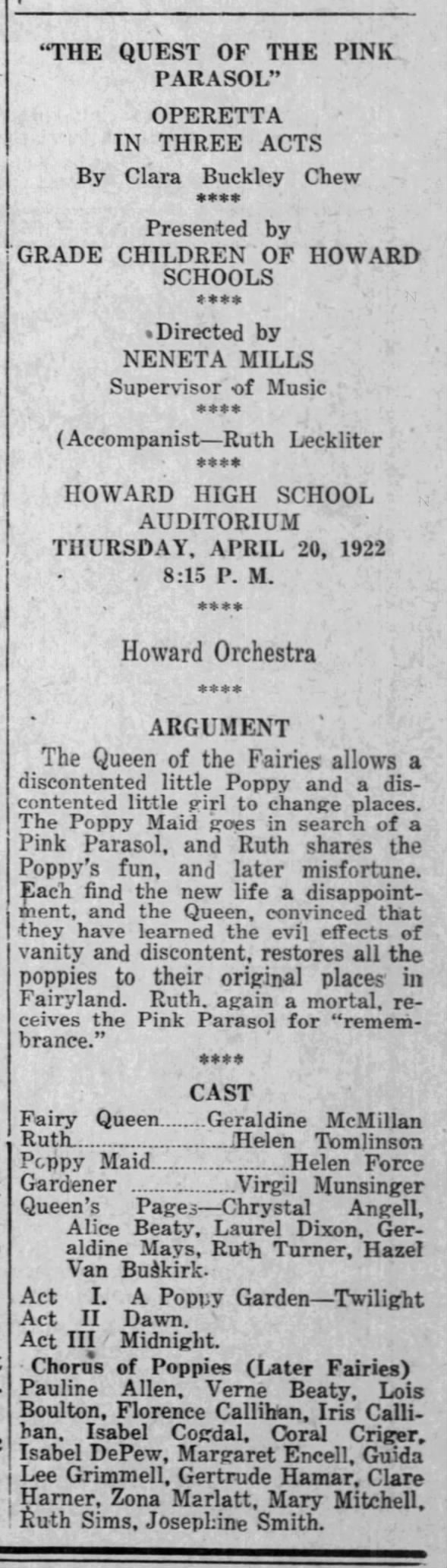
  • April 1922, cast in the school operetta, Quest of the Pink Parasol, as one of the "poppies" later turned into fairies. At a Christmas party that same year, hosted by her mother, Clare "held the place of honor" in the costume of a "Christmas fairy" (Howard Citizen, December 27, 1922). In 1923, Clare served as rehearsal accompanist for the next grade school production, "The House that Jack Built," billed as a "comic operetta."
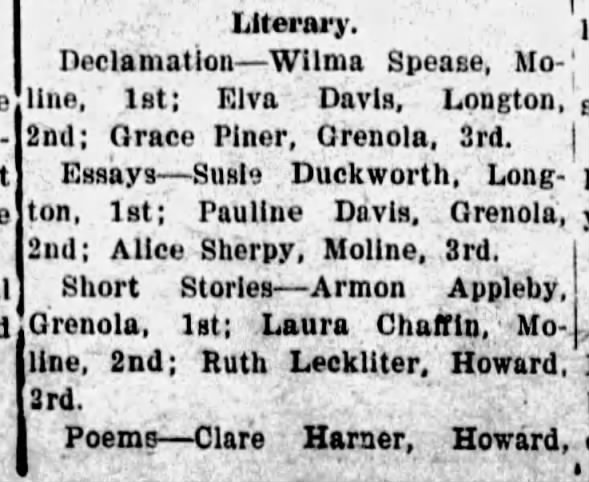
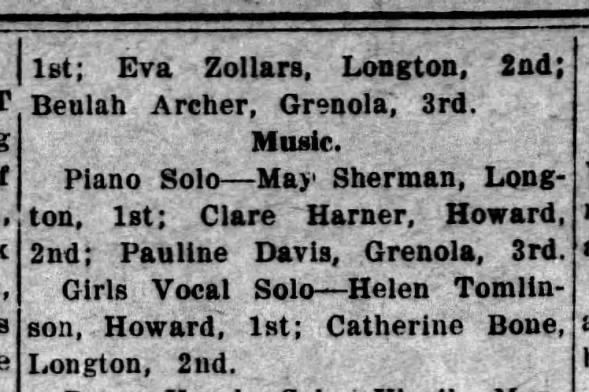
  • 1923-1926 Clare Harner attended Howard High School where she continued to excel at piano and violin; and regularly made the "honor roll" for academic progress. She performed several piano duets at public events with another student accompanist, Ruth Leckliter. Piano solo, Rhapsody Mignonne, performed in Howard on April 24, 1925 for the Elk County High Schools contest. In high school Clare Harner also won recognition for literary talents. In May 1925 an unidentified poem by Clare Harner won first prize at the "Elk County First Annual Track and Literary Meet," as reported on May 21, 1925 in the Moline Advance: 

Thu, May 21, 1925 – 1 · The Moline Advance (Moline, Kansas) · Newspapers.com
  • 1927-1929 after graduating from Howard High School, Clare Harner attended the College of Emporia, a small liberal arts college affiliated with the Presbyterian Church, fully enjoying its glory days before the Great Depression. At Emporia Clare Harner served as Secretary of The Minerva Society for which she contributed the annual summary signed ‘C. H.’ Mentions of Clare Harner in the school yearbook Alla Rah (Emporia, KS, 1928) appear on pages 108 and 113. 

Clare Harner in 1928 yearbook Alla Rah

  • At College of Emporia she also headed the literary Scribbler’s Club as ‘Chancellor’ before transferring to Kansas State (Emporia Gazette, September 21, 1928).
  • 1929-1931 Clare attended Kansas State University, then called Kansas State Agricultural College. In May 1929 Clare Harner was formally initiated into the Quill Club, as announced in the Kansas State Collegian on May 14, 1929. At Kansas State Clare Harner wrote articles for various student publications including the Kansas State Collegian and Brown Bull, the college humor magazine. 
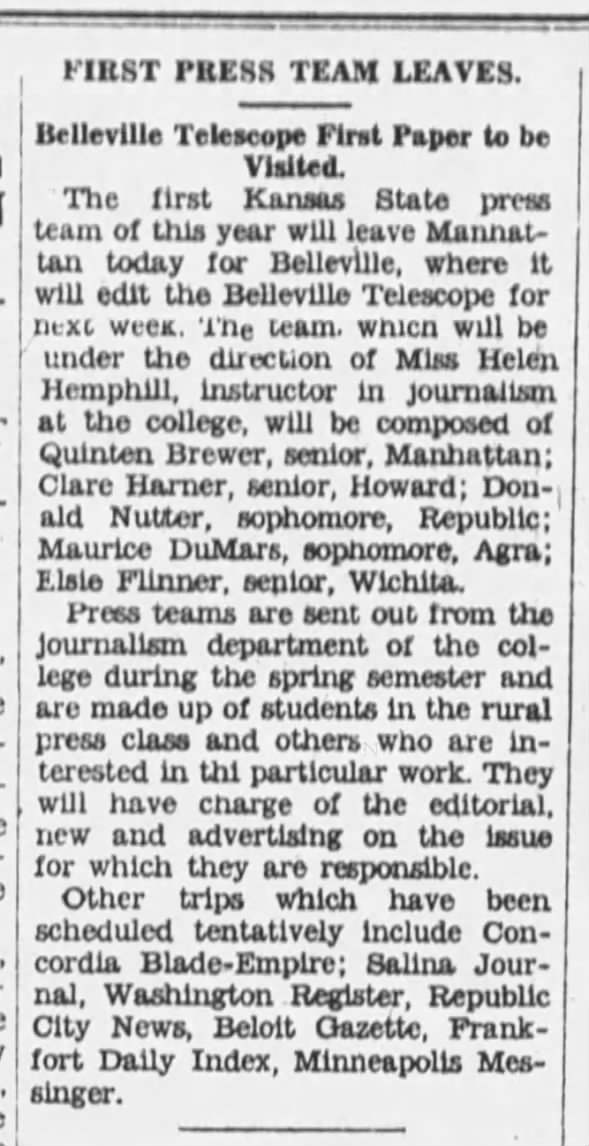
In March 1931, Clare Harner co-edited the weekly Belleville Telescope with a "press team" of Kansas State students, supervised by journalism instructor Helen Hemphill. Clare and four classmates were "allowed to take almost complete responsibility" for editing the March 19, 1931 issue of the Belleville Telescope.

13 Mar 1931, Fri The Morning Chronicle (Manhattan, Kansas) Newspapers.com

Clare joined Kappa Kappa Gamma sorority and graduated from Kansas State in 1931 with a degree in Industrial Journalism. 
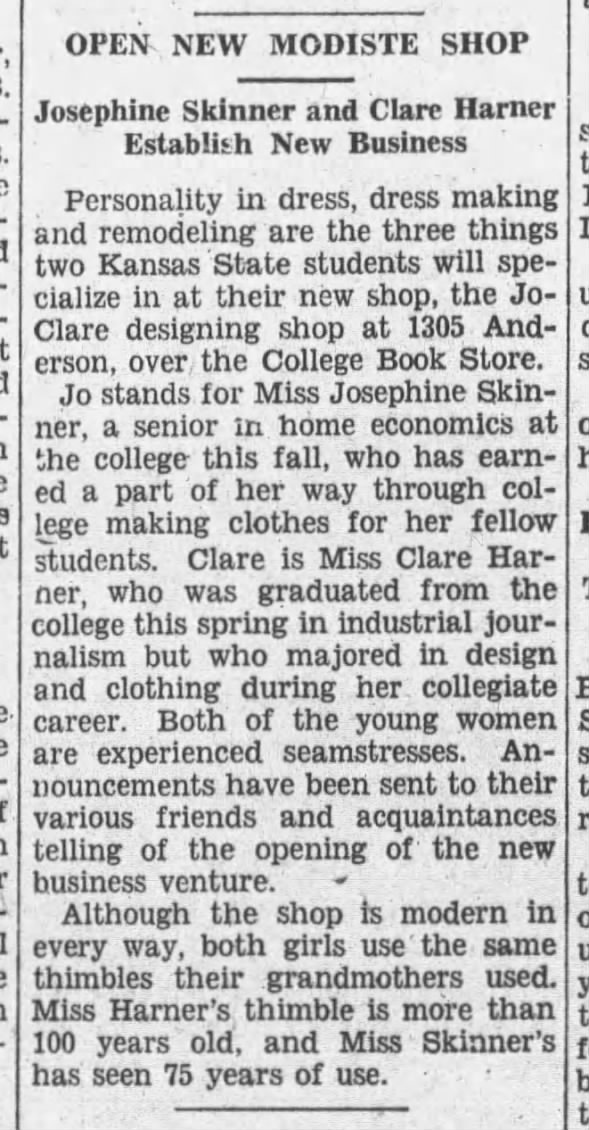
  • August 1931. With Kansas State senior Josephine Skinner, recent grad Clare Harner started Jo-Clare, a small business designing and making dresses. Jo-Clare operated above the college bookstore on Anderson Ave. in Aggieville. 
  • November 11, 1932, death of Clare's brother Olin Wade Harner (1901-1932). 
MR. OLIN HARNER  
Olin Wade Harner was born April 2, 1901 at Clay Center, Kansas and died at the home of his parents in Howard, Kansas, Friday, November 11, 1932. He had been teaching in Kansas City at the time of his illness, a year ago, at which time he came home.

The Harner family moved to Howard in 1912, from Clay Center, Kansas and Olin attended grade school and high school in this city. In 1924 he received his A.B. degree from Kansas University at which school he was a member of the Delta Tau Delta fraternity and secured a position in Kansas City Day School which he held for five years with the exception of one year leave of absence to recover his health. He was married to Helen Herron of Topeka, Kansas, July 30, 1932 at Howard, Kansas.

Services were held at the home of Dr. R. C. Harner at 10 a.m. Saturday, November 12, 1932. Funeral services and burial were at Clay Center, Kansas, Sunday, November 12th, at 2 o'clock. Dr. Ryerson, who had baptized Olin into the Methodist Episcopal church, conducted the services both at Howard and at Clay Center.

Olin Harner is survived by his wife, Helen Herron Harner; his parents Dr. and Mrs. R. C. Harner and his brother and sister, Collis and Clare.

Few deaths will be regretted more than that of Olin Harner by his many friends in Howard and elsewhere. He was a young man of outstanding ability and intellect, and his cheerful uncomplaining fight for health was a constant example of faith and optimism to his friends who were more fortunate in health. His profound comprehensive philosophy of life will continue to guide the lives of his friends and loved ones. All Howard joins the Harner family in mourning their loss.

The following resolutions were tendered Dr. Harner and family by the Country Day School of Kansas City with which Olin Harner was connected for five years preceding his death.

RESOLUTION

BE IT RESOLVED: by the members of the faculty of the Country Day School of Kansas City, Missouri that:

First: The death of Olin Harner has taken from us a valued friend and colleague whose presence, while among us, always radiated sunshine and whose absence during his illness was the cause of the deepest sorrow and regret.

Second: The death of "Olie," as he was affectionately called by those who knew him here, has occasioned an irreparable loss; He was loved by his students, esteemed by his co-workers and praised by his patrons.

Third: Olie's sojourn here will long remain a cherished memory among us -- pleasant disposition, his cheerfulness, his radiant smile still lives for us who knew him. May his loved ones find comfort in the affection he has left in the hearts of his friends.

Fourth: We express our deepest sympathy and pray that time may heal the wounds left in the hearts of his family.  -- Howard, Courant (November 15, 1934) via Kansas Trails, submitted there by Roland Hainey. 
  • Employed in 1934 as a social worker with the Kansas Emergency Relief Committee, Clare Harner superintended "an exhibit showing the clothing prepared for the needy of the state" (Howard Courant, November 15, 1934). 
  • After graduation Clare Harner lived and worked in Topeka, Kansas. Local directory shows that Clare resided with her surviving brother Collis and his wife Ruth. In Topeka, Clare found employment as a secretary while writing poetry and submitting verses to small poetry magazines like Expression and The Gypsy.
  • In December 1934, Clare Harner's original poem "Immortality" was published in The Gypsy all poetry magazine, edited in Cincinnati, Ohio by George Elliston. Attributed in The Gypsy to CLARE HARNER of Topeka, Kan., "Immortality" was reprinted in the Kansas City Times on February 8, 1935. The Gypsy published one other poem by Clare Harner, Where You Go, which appeared in the June 1936 issue.
  • In 1937 Clare lived in Denver, Colorado at 1113 E. Alameda according to city directory.
  • In 1938, three short poems by Clare Harner appeared in Important American Poets, edited by Edith Warren (New York, 1938). Her short pieces printed on page 274 are a haiku titled "Scarecrow"; "Puritan"; and "She Walked with Three." 
  • In 1939, Clare Harner's poem With No Ring is published in Eros (Henry Harrison, 1939), an anthology of love poems edited by Lucia Trent. In this year Clare Harner resides at 1973 Broadway in San Francisco, occupation Secretary; and registers to vote as Republican. 
Clare Harner Joins Fairchild Publications' San Francisco Staff

Mrs. Marl R. Hahlbeck, San Francisco news representative for the Fairchild Publications the past three years, is resigning and will be succeeded by Miss Clare Harner, who has previously done some special work for the organization. Mrs. Hahlbeck will join the San Francisco Call Bulletin as fashion editor. 
--Women's Wear Daily, Friday, October 20, 1939
  • In 1940 Kansas Magazine published a selection of then recent poetry by Kansas writers including two poems by Clare Harner: "War Chant" and "Cry from the Dust Bowl," printed on pages 56-57. Her bio appeared in the back with those of other contributors to the 1940 issue:
    CLARE HARNER was born, reared, and educated in Kansas but now calls San Francisco her home town, for she has recently been appointed correspondent for Fairchild Publications in the bay area. Miss Harner has done newspaper, magazine, and advertising agency work in Topeka, Denver, Hollywood, and San Francisco. She grew up in Howard and was educated at Kansas State College. -- Kansas Magazine (1940) page 127.
  • 1941, the short poem Challenger by Clare Harner is published in Cycle Vol. 7 No. 2 (June 1941) on page 14. 

    October 9, 1943 marriage of Clare Harner and David Lyon in San Francisco
  • October 9, 1943: Clare Harner married Sergeant David Haines Lyon, USMC. Announcement in Kappa Kappa Gamma Key for December 1944 Key indicates "October 1944" but later notice in April 1946 issue of The Key gives wedding date of October 9, 1943 and specifies place of the ceremony as home, 994 Union Street in San Francisco. 
  • In 1945 Clare Harner Lyon was employed as "clerk" with McCann-Erickson advertising company. With the end of WWII her husband David Haines Lyon was honorably discharged from military service on October 29, 1945. Draft Card identifies his wife, "Mrs. David Haines Lyon" as "NAME OF PERSON WHO WILL ALWAYS KNOW YOUR ADDRESS." At this time David and Clare Lyon reside at 2420 Leavenworth in San Francisco, CA. 

    Clare and David Lyon had two children, daughters Nancy Jane Lyon (b. 1947) and Martha Clare Lyon (b. 1950).  

  • April 1961. "Clare Lyon, formerly production manager with Roy S. Durstine, Inc. (now Beaumont-Hohman & Durstine, Inc.) has been named production manager of California Medicine, journal of the California Medical Association."
  • 1970 City Directory lists Mrs. Clare Harner Lyon residing at 4336 Irving in San Francisco, CA.
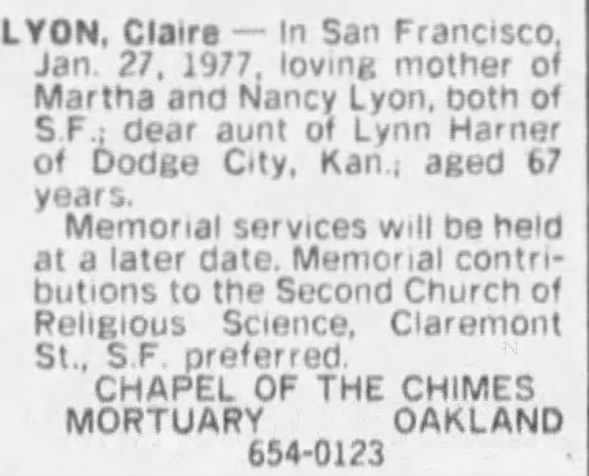
  • January 27, 1977, death of Clare Harner Lyon in San Francisco, age 67. Her 1977 funeral notice indicates that she belonged to or was somehow affiliated with the Second Church of Religious Science on Claremont Street.
Obituary for Claire LYON (Aged 77)Obituary for Claire LYON (Aged 77) Sun, Jan 30, 1977 – 25 · The San Francisco Examiner (San Francisco, California) · Newspapers.com

Friday, January 29, 2021

Clare Harner in Quest of the Pink Parasol

In April 1922 Clare Harner, age 12, appeared in her grade-school musical, an "operetta" for children titled The Quest of the Pink Parasol. As shown in this announcement from the local newspaper, Clare was cast in the Chorus of Poppies, later fairies. Directed by Neneta Mills, Supervisor of Music, with student accompanist Ruth Leckliter. 

Wed, Apr 19, 1922 – 1 · The Citizen (Howard, Kansas) · Newspapers.com
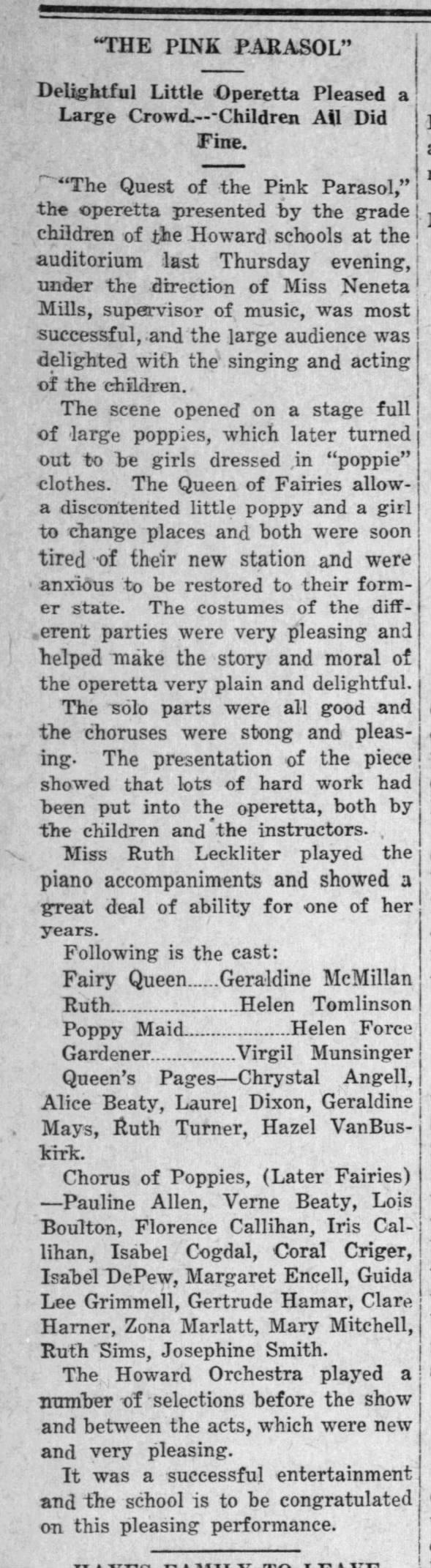
Happily, the "children all did fine" according to the wonderful review published in the Howard Citizen on April 26, 1922. 
"The solo parts were all good and the choruses were strong and pleasing."
Wed, Apr 26, 1922 – 1 · The Citizen (Howard, Kansas) · Newspapers.com

Friday, December 25, 2020

Challenger


Challenger

Where does he go,
       The daring one?
He follows the road
       That leads to the sun. 

Is the going rough
       The highway wide?
The road is long--
       But so is his stride!

And does he guess
       What lies ahead?
He only knows
       That he is led . . .

Drawn by a will
       Greater than his
To look for the sun
       And a Power that is.

--Clare Harner.

From Cycle Vol. 7 No. 2 (June 1941) page 14. Devoted to shorter poetry and reviews, Cycle magazine was then published in Houston, Texas and edited by Lily Lawrence Bow (1870-1943).

Dianne Scott tells the story of How Bow Channel Got Its Name.


Wednesday, December 23, 2020

With No Ring


With No Ring

People pass with averted eyes--
For I'm the sort their creeds despise.
No one believes I'd send you away.
Everyone thinks I begged you to stay.

The nicest women pass me by.
With questioning brows they wonder, "Why?"
They hold their skirts aside with care
Though the walk is broad with room to spare.

For a lady must wear a wedding ring:
A woman who can't is a leprous thing!
Why did you leave me alone like this?
An outcast because I loved your kiss.

CLARE HARNER.

As published in Eros (Henry Harrison, 1939), edited by Lucia Trent.

Tuesday, December 15, 2020

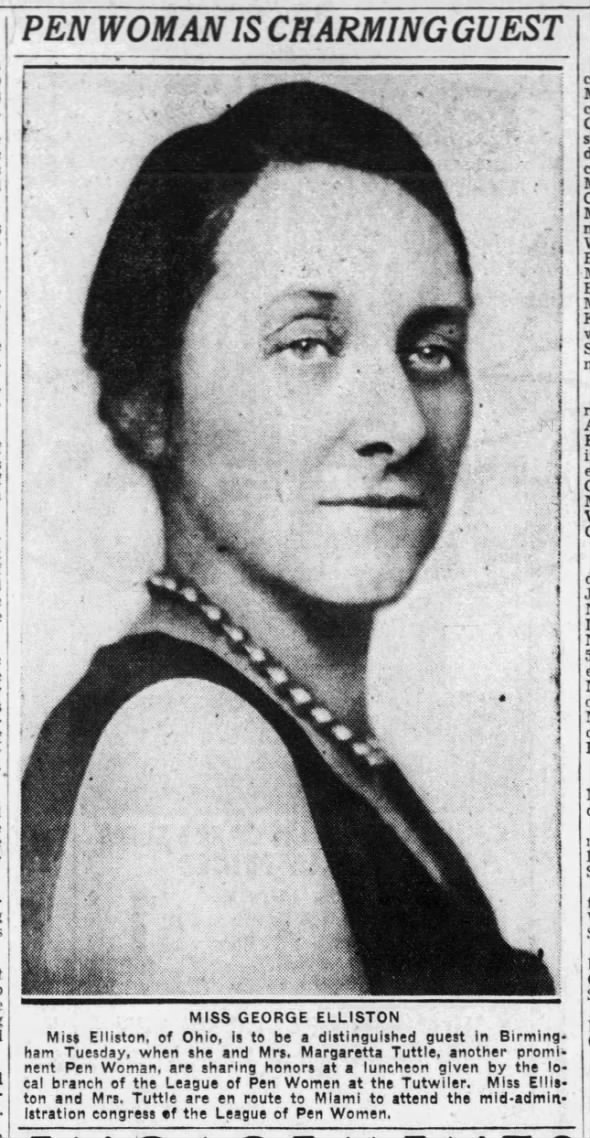
George Elliston, editor of The Gypsy poetry magazine

"... a reporter who was tough as nails and could spit the same."
-- George Elliston as described by Kevin Grace in Cincinnati's Literary Heritage (History Press, 2021)
Sun, Mar 24, 1935 – 24 · The Birmingham News (Birmingham, Alabama) · Newspapers.com
George Elliston (1883-1946) founded and edited The Gypsy all poetry magazine in Cincinnati, Ohio. Elliston's Gypsy published two poems by Kansas native Clare Harner, "Immortality" (December 1934) and Where You Go (June 1936). Clare Harner's Immortality is nowadays more popularly known by its first line "Do not stand by my grave and weep" or "Do not stand at my grave and weep." 

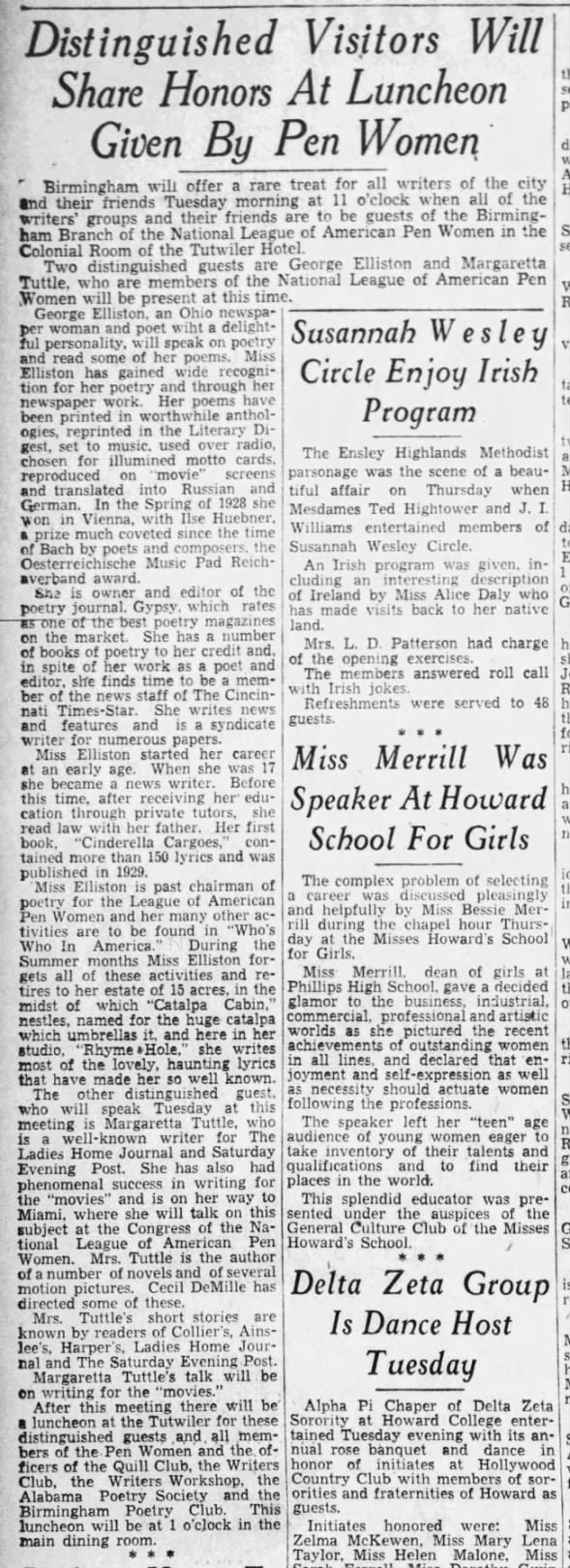
From the Birmingham AL News, March 24, 1935:
... George Elliston, an Ohio newspaper woman and poet with a delightful personality, will speak on poetry and read some of her poems. Miss Elliston has gained wide recognition for her poetry and through her newspaper work. Her poems have been printed in worthwhile anthologies, reprinted in the Literary Digest, set to music, used over radio, chosen for illumined motto cards, reproduced on “movie” screens and translated into Russian and German. In the Spring of 1928 she won in Vienna, with Ilse Huebner, a prize much coveted since the time of Bach by poets and composers, the Oesterreichische Music Pad Reichsverband award. 

She is owner and editor of the poetry journal Gypsy, which rates as one of the best poetry magazines on the market. She has a number of books of poetry to her credit and, in spite of her work as a poet and editor, she finds time to be a member of the news staff of The Cincinnati Times-Star. She writes news and features and is a syndicate writer for numerous papers.

Miss Elliston is past chairman of poetry for the League of American Pen Women and her many other activities are to be found in “Who’s Who in America.” During the Summer months Miss Elliston forgets all of these activities and retires to her estate of 15 acres, in the midst of which “Catalpa Cabin,” nestles, named for the huge catalpa which umbrellas it, and here in her studio, “Rhyme Hole,” she writes most of the lovely, haunting lyrics that have made her so well known....
Sun, Mar 24, 1935 – 24 · The Birmingham News (Birmingham, Alabama) · Newspapers.com
Link to George Elliston bio in The Encyclopedia of Northern Kentucky:

https://books.google.com/books?id=Zc0eBgAAQBAJ&pg=PA299&lpg=PA299&dq#v=onepage&q&f=false

Clare Harner’s ‘Immortality’ (1934)

Clare Harner’s ‘Immortality’ (1934): SINCE its rediscovery by John Wayne in 1977,1 the bereavement poem that begins ‘Do not stand at [by] my grave and weep’ has been variously traced to Hopi and....

Tuesday, December 1, 2020

Well known poem by Clare Harner Lyon

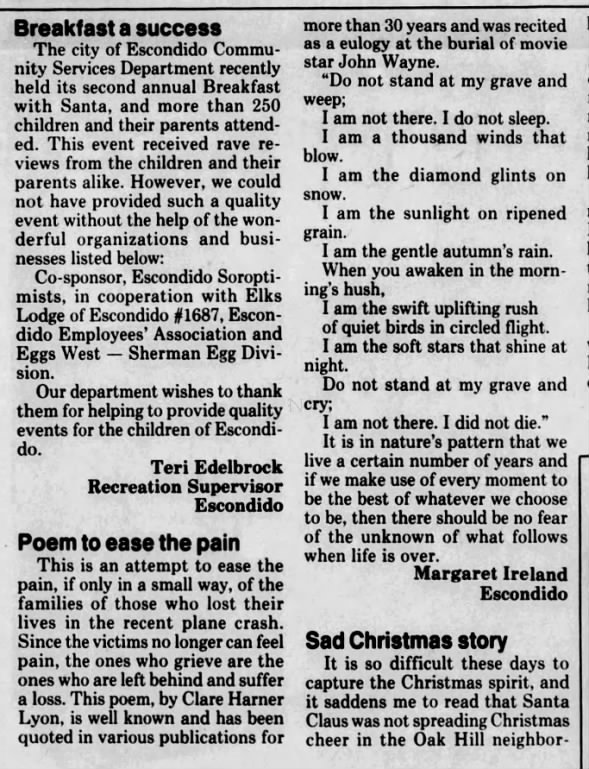
In this 1988 letter to the editor of the Escondido CA Times-Advocate, Margaret Ireland correctly identified Clare Harner Lyon as the author of the popular bereavement poem "Do not stand at my grave and weep." Among other changes in the version quoted by Ms. Ireland, "uplifting" replaces "up-flinging"; and the line "I am the soft stars that shine at night" replaces "I am the day transcending night" in the original 1934 text of Clare Harner's Immortality

Poem to ease the pain

This is an attempt to ease the pain, if only in a small way, of the families of those who lost their lives in the recent plane crash. Since the victims no longer can feel pain, the ones who grieve are the ones who are left behind and suffer a loss. This poem, by Clare Harner Lyon, is well known and has been quoted in various publications for more than 30 years and was recited as a eulogy at the burial of movie star John Wayne.

 "Do not stand at my grave and weep; 

I am not there., I do not sleep.

I am a thousand winds that blow.

I am the diamond glints on snow.

I am the sunlight on ripened grain.

I am the gentle autumn's rain.

When you awaken in the morning's hush,

I am the swift uplifting rush

of quiet birds in circled flight.

I am the soft stars that shine at night.

Do not stand at my grave and cry;

I am not there, I did not die."

It is in nature's pattern that we live a certain number of years and if we make use of every moment to be the best of whatever we choose to be, then there should be no fear of the unknown of what follows when life is over.

Margaret Ireland
Escondido

Thu, Dec 29, 1988 – 19 · Times-Advocate (Escondido, California) · Newspapers.com
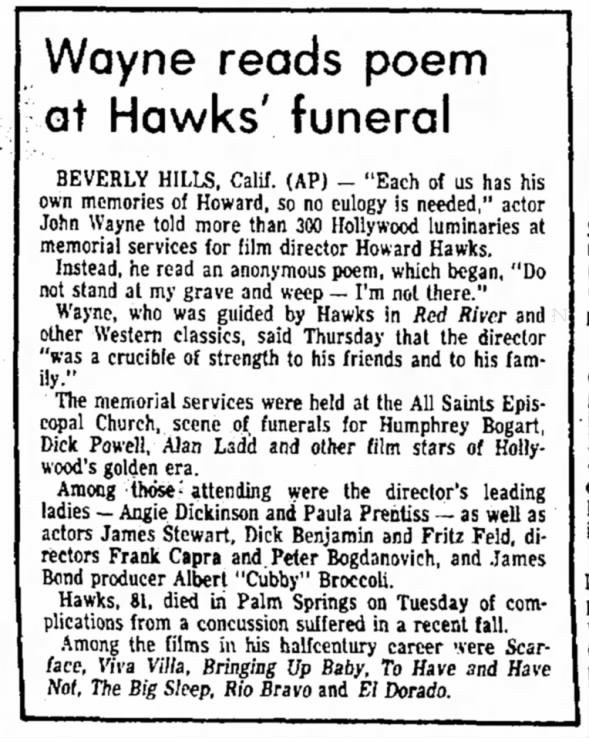
As shown below, in December 1977 the supposedly "anonymous poem" was read by John Wayne at the funeral of film director Howard Hawks

Fri, Dec 30, 1977 – Page 89 · Abilene Reporter-News (Abilene, Texas) · Newspapers.com

Sunday, November 22, 2020

Paul Henniger rightly credits Clare Harner Lyon

In June 1982 syndicated columnist Paul Henniger correctly identified Clare Harner Lyon as the author of popular eulogy "Do not stand at my grave and weep," alternatively titled "Do not stand by my grave and weep" or "Immortality."

Sun, Jun 13, 1982 – 414 · The San Francisco Examiner (San Francisco, California) · Newspapers.com

From the San Francisco Examiner, June 13, 1982: 

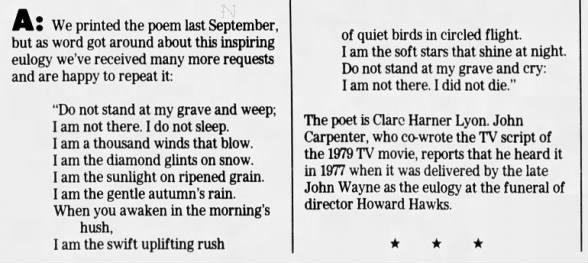
We printed the poem last September, but as word got around about this inspiring eulogy we've received many more requests and are happy to repeat it: 

"Do not stand at my grave and weep;

I am not there. I do not sleep.

I am a thousand winds that blow. 

I am the diamond glints on snow. 

I am the sunlight on ripened grain.

I am the gentle autumn's rain.

When you awaken in the morning's hush,

I am the swift uplifting rush

of quiet birds in circled flight.

I am the soft stars that shine at night.

Do not stand at my grave and cry:

I am not there. I did not die."

The poet is Clare Harner Lyon. John Carpenter, who co-wrote the TV script of the 1979 TV movie, reports that he heard it in 1977, when it was delivered by the late John Wayne as the eulogy at the funeral of director Howard Hawks.  --Paul Henniger

The poem known as "Do not stand at my grave and weep" was first printed under the title "Immortality" in a Cincinnati poetry magazine called The Gypsy, as shown in my 2018 article Clare Harner's 'Immortality' (1934). The tenth line as reprinted in the San Francisco Examiner on June 13, 1982 reads

"I am the soft stars that shine at night."

replacing

"I am the day transcending night."

in the text as originally published December 1934 in The Gypsy  It seems that the later revision to "I am the soft stars that shine at night" may have been made by the author herself--possibly after her marriage to David Haines Lyon in October 1943, which would explain Henniger's use of Clare Harner's married name, Clare Harner Lyon.

In March 1980 and November 1981 Henniger had reprinted the poem without attribution. 

"The identity of the poet is unknown, according to NBC. The writer of the teleplay, John Carpenter, reports that he heard it in 1977 when it was delivered by the late John Wayne at the funeral of film director Howard Hawks."

Sometime during the next six months Henniger must have learned that San Francisco resident Clare Harner Lyon wrote the poem. One year later, rival TV columnist Richard K. Shull launched the dubious and unverifiable claim for Mrs. Mary E. Frye of Baltimore as the admirably unpretentious author of "Do not stand at my grave and weep." Shull's appealing 1983 tale was influentially amplified by Kelly Ryan in a dramatic episode of the Canadian radio program "Ideas" titled A Poetic Journey, first broadcast on CBC in May 2000. 

Paul Henniger's obituary from the Los Angeles Times, May 21, 1999: 

Paul Henniger; Former L.A. Times TV Writer
Paul Henniger, 78, former television writer for Los Angeles Times Syndicate and The Times. Born in San Francisco, Henniger moved to Los Angeles in 1946. He worked for The Times’ sister paper The Mirror from 1948 until it folded in 1961 and then for The Times in its television news section until his retirement in 1994. For many years, Henniger helped create the newspaper’s logs of television listings and wrote a weekly column about sport programs on television. Throughout his career, Henniger also wrote a television column and numerous features for the Times syndicate, which marketed the articles to newspapers throughout the country. On May 9 in Encino of pneumonia. 
https://www.latimes.com/archives/la-xpm-1999-may-21-me-39445-story.html

Monday, August 13, 2018

Let the Surging Waters . . .

From "Choir Practice" (a monthly column of contemporary poetry selected by Ellen M. Carroll) in the Charleston Evening Post (Charleston, South Carolina), February 15, 1936:
Charleston, SC Evening Post - February 15, 1936
via GenealogyBank
LET THE SURGING WATERS . . .
Give him a rugged voyage, Lord,
As he comes to Death's uncharted fiord.

In Life, he loved the rampant gale
   And laughed to watch the jagged dart
   Of lightning tear the clouds apart,
And shouted with joy at the wind and hail.

He never thought that calm was right . . .
   Quarter was given but never sought,
   Nor peace desired by him, who fought
And thrilled to feel the urge to fight.
Lord, give him a plunging ship—
He would not rest on a quiet trip.
—Clare Harner, Kansas.

Monday, August 6, 2018

And There Was Light by Clare Harner

From "Choir Practice" (a monthly column of contemporary poetry selected by Charleston poet Ellen M. Carroll) in the Charleston, South Carolina Evening Post, August 14, 1936:


Charleston, SC Evening Post - August 14, 1936
via GenealogyBank


AND THERE WAS LIGHT
Because I knew the day had passed,
I did not see that the shades were fast:
   For there was no light within
      To keep from shining out.
   Nor light outside coming in—
      And my heart was filled with doubt.

And then one tiny ray, from where
It came, and how, I do not care:
   In whirling, brave advance
      It marched across the floor.
   By some uncanny chance
      My room was dark no more.

Then I lit a candle, pulled the shades
And practiced some lilting serenades.
All at once, my heart was light.
Queer to have been afraid of night!
—Clare Harner, Kansas.

Where You Go

Sat, Aug 8, 1936 – 4 · The Central New Jersey Home News (New Brunswick, New Jersey) · Newspapers.com

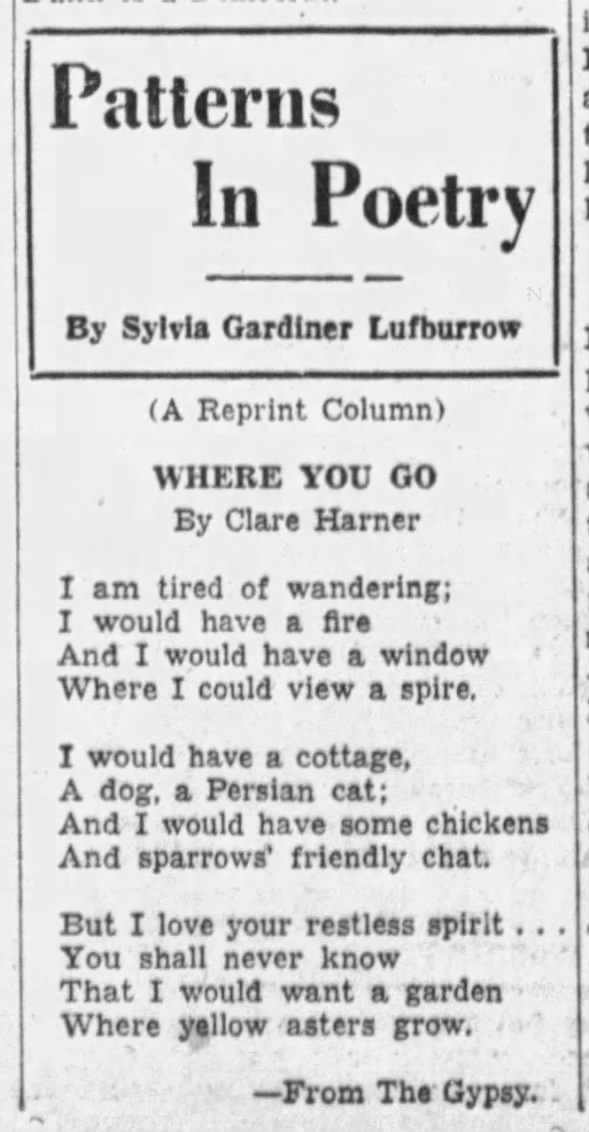
WHERE YOU GO
By Clare Harner

I am tired of wandering;
I would have a fire
And I would have a window
Where I could view a spire.

I would have a cottage,
A dog, a Persian cat;
And I would have some chickens
And sparrows' friendly chat.

But I love your restless spirit . . .
You shall never know
That I would want a garden
Where yellow asters grow.

—From The Gypsy
Reprinted from The Gypsy poetry magazine, volume 12 (June 1936) page 15. This is the second of two poems by Clare Harner in The Gypsy. The first was Clare Harner's Immortality, published in the December 1934 issue.

Sigma Delta Chi award

Thu, Apr 16, 1931 – 8 · Manhattan Republic (Manhattan, Kansas) · Newspapers.com

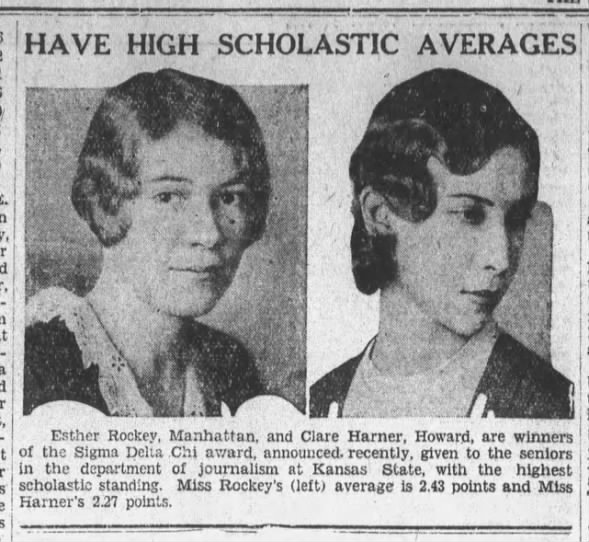
"Esther Rockey, Manhattan, and Clare Harner, Howard, are winners of the Sigma Delta Chi award, announced recently, given to the seniors in the department of journalism at Kansas State, with the highest scholastic standing. Miss Rockey's (left) average is 2.43 points and Miss Harner's 2.27 points." --Manhattan Republic (Manhattan, Kansas), April 16, 1931.

Thu, Jan 15, 1931 – 1 · The Manhattan Mercury (Manhattan, Kansas) · Newspapers.com

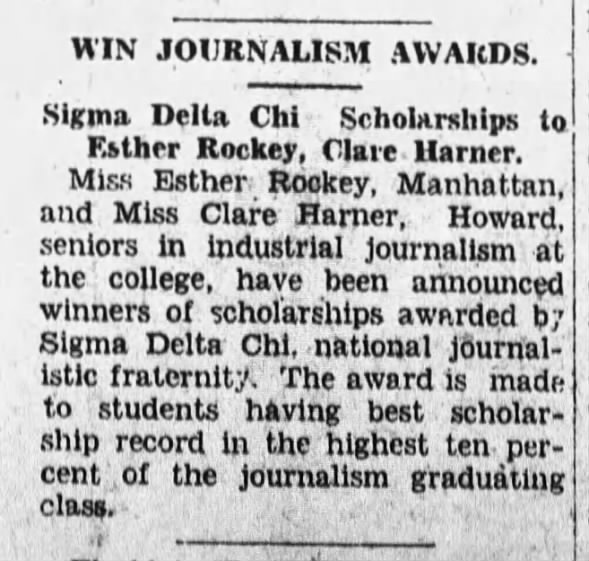
WIN JOURNALISM AWARDS.
Sigma Delta Chi Scholarships to Esther Rockey, Clare Harner.

"Miss Esther Rockey, Manhattan, and Miss Clare Harner, Howard, seniors in industrial journalism at the college, have been announced winners of scholarships awarded by Sigma Delta Chi, national journalistic fraternity. The award is made to students having best scholarship record in the highest ten percent of the journalism graduating class." --The Manhattan Mercury (Manhattan, Kansas), January 15, 1931.